The Independent Financial Advisor’s Marketing Plan Template: A Step-by-Step Guide
Most financial advisors market without a real plan. Get a free written guide covering positioning, channels, content, lead gen, compliance, and measurement.
Updated: 08/3/2026 by Cullen Fischel
Topic: Financial Advisor Marketing

Most advisors are marketing without a plan
Most independent advisors are running marketing activity, not a marketing plan. A Broadridge study found that 77% of financial advisors have no defined marketing strategy, and later industry reporting puts the number of advisors with a defined strategy at under 30%. Time, not desire, is usually the reason: a Broadridge survey reported by InvestmentNews found that 85% of advisors lack a marketing strategy because they don't have time to build one.
Without a written plan, marketing becomes a rotation of disconnected tactics: a LinkedIn post here, a client seminar there, a website redesign every few years. Advisors in this pattern often struggle with inconsistent follow-up, weak differentiation, and no real way to measure whether any of it produced a client.
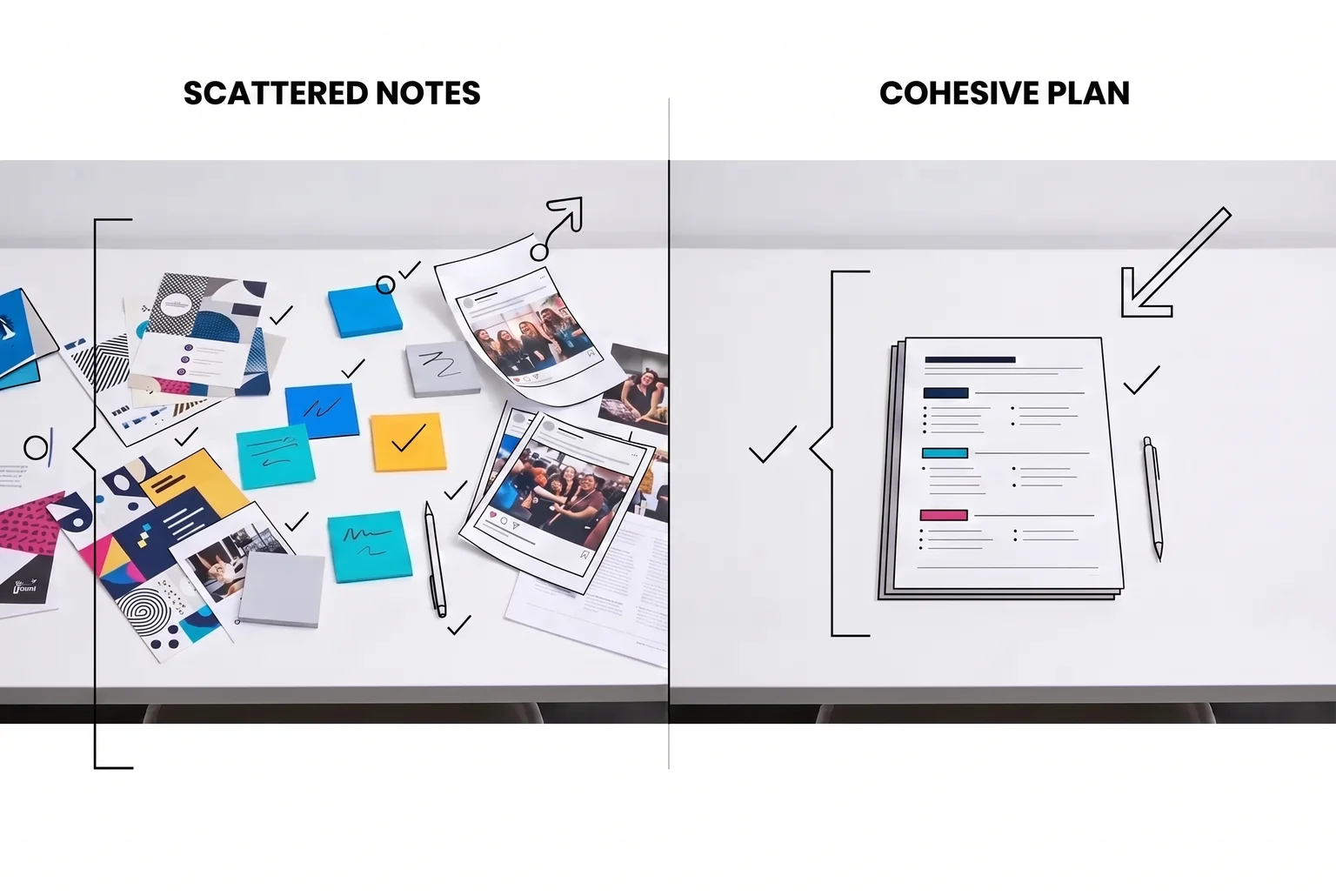
This guide gives you a complete, written template covering:
- Positioning: who you serve and why they should choose you
- Channels: which platforms deserve your limited time
- Content: a system for consistent messaging
- Lead generation: turning attention into actual prospects
- Compliance: guardrails under the SEC Marketing Rule that apply to what you publish in every step above
- Measurement: a simple way to know what's working
The compliance step isn't a one-time checkbox at the end. It governs decisions you make earlier, particularly what you say in testimonials, endorsements, and performance claims, so it's worth keeping in mind as you build each earlier section of the plan.
Step 1: Pick your target client
Every other decision in this plan, your website copy, your content topics, your lead magnets, depends on knowing who you're writing for. Skip this step and you'll build a generic practice that competes on price against every other advisor in your area.
Worksheet: selecting your niche
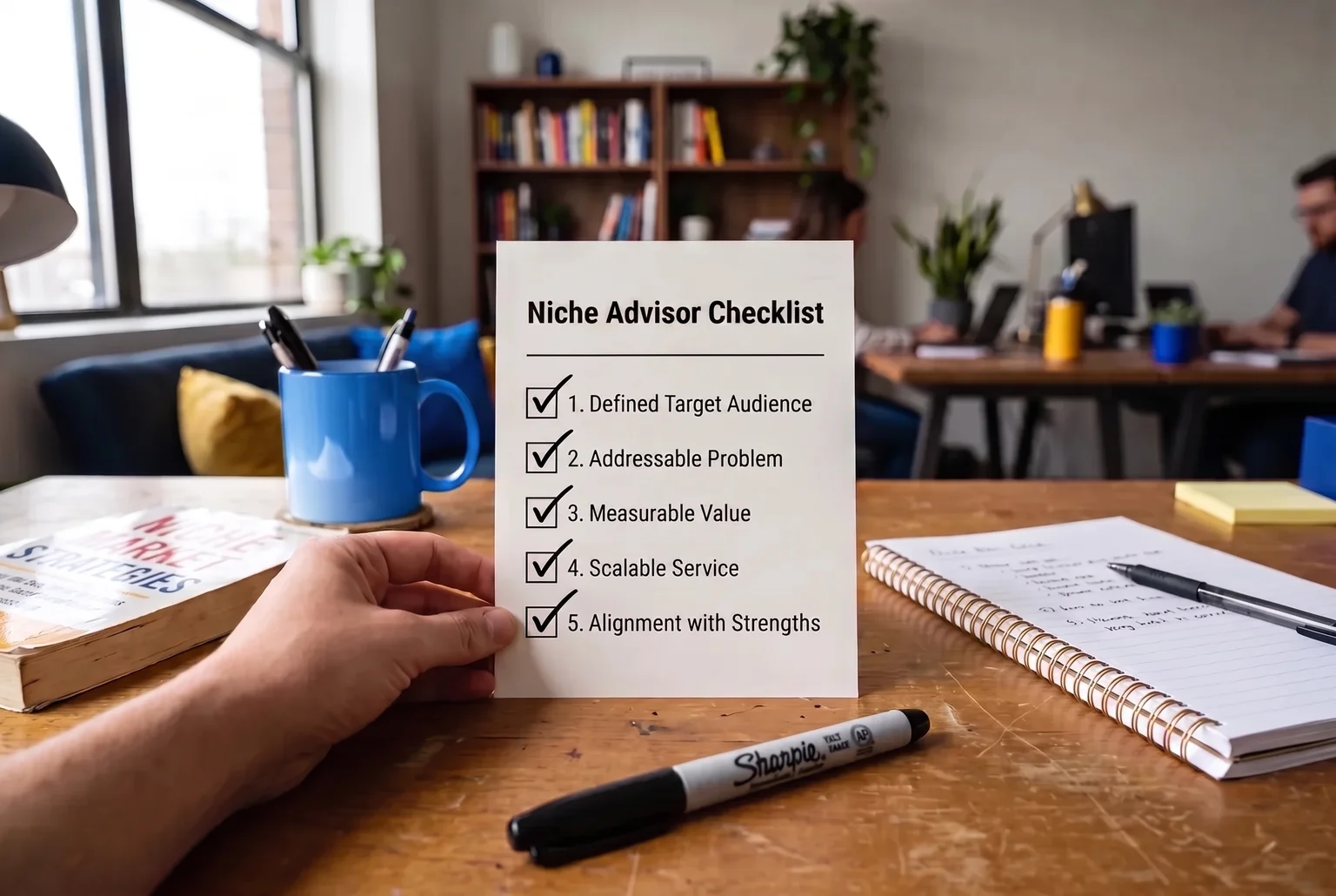
Work through these filters before you write a single word of marketing copy:
- Personal fit. Which clients do you actually enjoy working with? Carson Group notes that advisors who choose niches based on genuine interest tend to stick with the work long enough to build real expertise in it.
- Financial qualification. Does this group have money now, or will they have it soon? Bill Good Marketing lists current or imminent wealth as a baseline filter, alongside having a problem you can actually solve.
- Reachability. Can you consistently get in front of this audience through associations, employers, referral networks, or content channels, not just occasional luck.
- Competitive density. Search for other advisors serving this niche in your geography. OJay Media suggests that more than 50 competitors may signal saturation, while 5 to 50 sits in a workable range.
- Existing book of business. Look at your current clients. Where do you already have traction and referral momentum?
Positioning statement templates
Once you've settled on a niche, put it into words using one of these fill-in-the-blank structures (treat the bracketed language as illustrative, not a script to copy verbatim):
"I help [specific audience] achieve [specific outcome] through [distinct approach], so they can [life or emotional result]."
"For [target client] who want [primary outcome], [firm name] provides [unique approach] unlike [primary competitor], because [reason to believe]."
Fill in each blank with specifics, not generic language like "financial security" or "peace of mind." A statement for divorced women over 50 rebuilding retirement plans reads very differently than one for tech employees managing concentrated stock positions, and it should.
Before you move to channels, write this statement down. You'll reference it constantly in the steps ahead.
Step 2: Match your channels to your niche
Referrals still outperform everything else advisors try. Client referrals convert at a 95% success rate and generate about $5,000 in revenue per client, and referrals from centers of influence like CPAs and attorneys convert at 85% and produce similar revenue. That doesn't mean referrals are your whole plan. It means they belong at the center of it, with other channels built to support and multiply them rather than replace them.
Run each candidate channel through three filters:
Audience fit. Where does your niche actually spend attention? A niche of retiring engineers behaves differently online than a niche of small business owners in their 30s. Guessing wastes budget; check where your existing clients already engage.
Time and resource cost. SEO content pays off slowly but compounds, with a long-run cost per lead in the $15 to $60 range that tends to fall as your content library grows. Email marketing, used by only 37% of advisors, requires less production time and works well once you already have a list to nurture. Video and social media (particularly LinkedIn) demand more consistent output but can build authority faster.
Compliance complexity. Any channel featuring client testimonials, ratings, or performance claims triggers additional review under SEC rules, covered in Step 5. Factor that review time into your channel choice now, not after you've already recorded the video.

Common mistake: spreading across five channels at once. Advisors who try to run SEO, email, video, and two social platforms simultaneously with no staff usually produce mediocre content everywhere and finish nothing well. Pick two or three channels you can sustain for a full year, execute them consistently, and add more only after the first ones run without constant attention.
Step 3: Turn your positioning into a repeatable content plan
Your positioning statement from Step 1 is only useful if it shows up consistently in what you publish. A content calendar is where that translation happens: it turns "I help X client with Y problem" into actual topics, on an actual schedule.
Start with three to four content pillars tied directly to your niche. Most advisor content splits into education (explaining tax-efficient withdrawal sequencing, Roth conversions, RMDs), planning topics (retirement income, business owner exit planning), and life-event triggers (open enrollment, year-end tax moves, quarterly estimated tax deadlines). Layer in stories or anonymized client scenarios to show the planning in practice. A fourth pillar worth adding: myth-busting or contrarian takes that respectfully challenge conventional financial wisdom, which is a way to stand out in a niche where most advisors sound identical.
Pro Tip: Every piece of content should trace back to a specific line in your positioning statement. If you can't connect a topic to your target client or your differentiator, cut it, even if it's a trending topic.
For structure, keep the calendar visible with columns for date, platform, topic, format, target pillar, CTA, and status. Add a workflow column tracking draft, compliance review, disclosures added, final approval, and published.

As an illustrative starting point, not a fixed rule, many solo advisors aim for one long-form pillar piece per month, two to four supporting social posts per week, and a monthly or biweekly newsletter. Adjust based on the channel mix you picked in Step 2 and how much time you can sustain without burning out by month three.
One flag now: if any content on this calendar includes a client testimonial, endorsement, or performance claim, mark it in your status column for compliance review before it goes live. Step 5 covers exactly what that review needs to include under SEC rules, and skipping it is one of the easier mistakes to make when you're moving fast on a publishing schedule.
Step 4: Turn traffic into leads with a magnet, a landing page, and a follow-up sequence
Content builds trust, but it rarely converts on its own. Lead generation needs an offer worth trading an email address for, a landing page that captures it, and a follow-up sequence that moves the prospect toward a conversation.
Start with the offer. Retirement-focused lead magnets tend to perform well for advisors: retirement checklists, interactive calculators, and short webinars are consistently cited as strong-converting formats across advisor marketing sources. Supplement these with tax-planning guides, Social Security optimization guides, estate-planning checklists, or Roth conversion worksheets, matched to your niche from Step 1. One frequently cited figure worth treating as a rough benchmark rather than a guarantee: retirement income calculators aimed at prospects with $300K to $2M in assets have reportedly seen opt-in rates of 18-26%. Your own numbers may land well outside that range depending on traffic quality, offer relevance, and how the landing page is built.

Once someone opts in, the follow-up sequence does the real work. A practical structure follows three stages over roughly three to ten days:
- Day 1, welcome: deliver the promised material immediately, introduce yourself briefly, and set expectations for what emails they'll get and how often.
- Day 3 to 4, value: send one focused educational tip or resource tied to a common problem your niche faces, building credibility without a hard pitch.
- Day 7 to 10, consultation CTA: outline what a first meeting looks like and include a simple scheduling link, low-pressure and specific.
Keep the lead magnet content itself compliance-aware. Retirement calculators, tax guides, and similar tools should stick to general education rather than implying guaranteed outcomes or specific results. And if you plan to use a client testimonial, review, or performance reference anywhere in your nurture emails, hold off. Step 5 walks through the SEC compliance checklist those materials need to pass before they go anywhere near a prospect's inbox.
Step 5: Testimonials, endorsements, and performance claims
Before any content from Steps 2 through 4 goes live, run it through the SEC Marketing Rule (Rule 206(4)-1), which governs how registered investment advisers can use testimonials, endorsements, and performance claims in advertising. This isn't a one-time check. Apply this checklist retroactively to your website testimonials, video reviews, social proof, and any client stories baked into lead magnets or nurture emails.
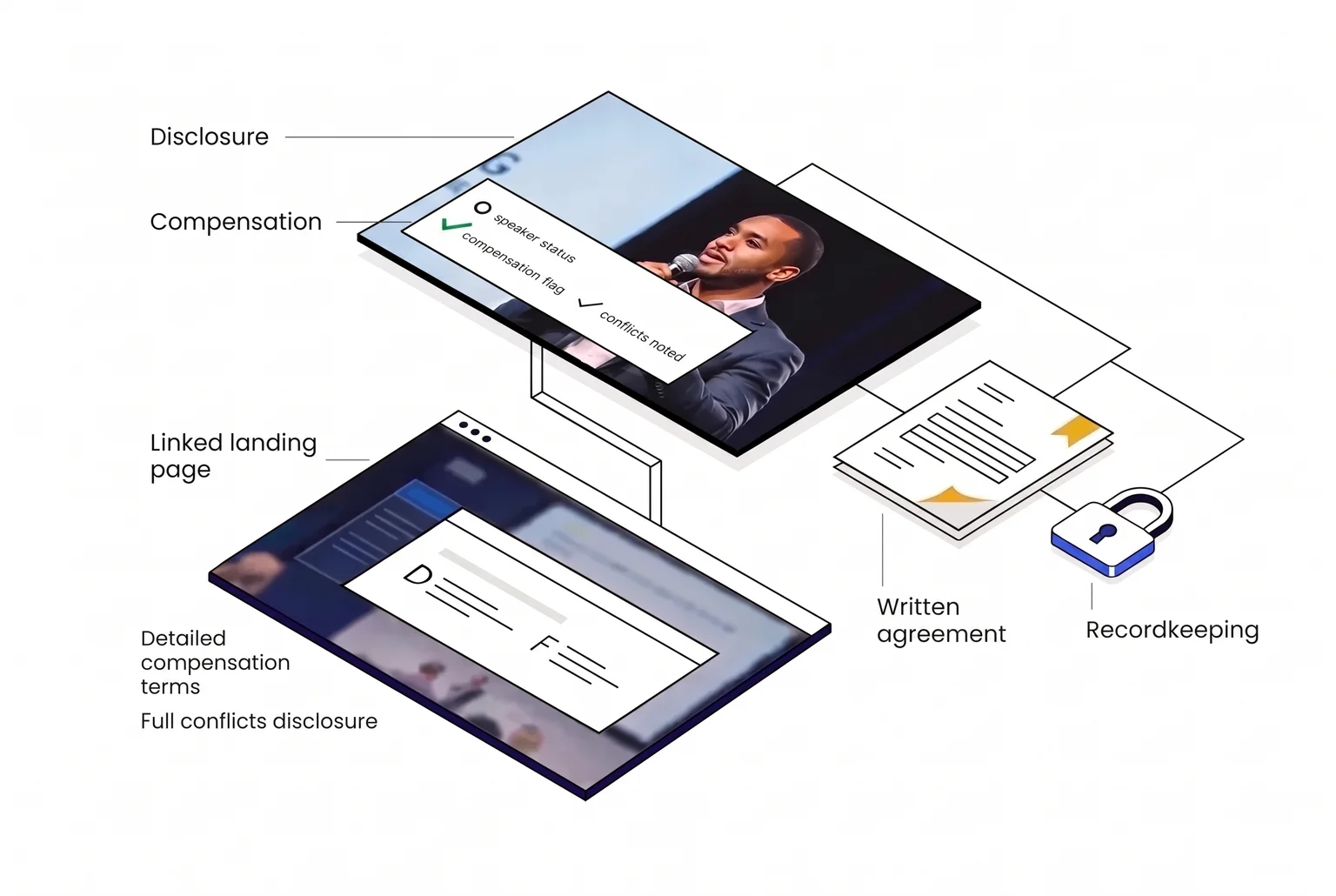
The rule allows testimonials and endorsements, but only with specific disclosures made clearly and prominently at the time of dissemination. Work through this checklist for anything featuring a client's or third party's words:
- Disclose whether the speaker is a client or non-client.
- Disclose whether they received cash or non-cash compensation.
- Include a brief statement of any material conflicts of interest.
- Provide a second layer of detail, covering the compensation arrangement and full conflicts, on an easily accessible linked page.
- Confirm the person is not an "ineligible person" under the rule's disqualification standards, particularly if you're paying anyone more than a token amount.
- Put a written agreement in place with any promoter compensated above $1,000 in a 12-month period, unless they're an affiliate.
- Keep records showing you had a reasonable basis to believe the material complies before you published it.
Performance claims carry their own requirement: gross performance figures need net performance shown with equal prominence, calculated the same way over the same period.
None of this is a substitute for legal judgment. Rule interpretations shift, exceptions exist for certain broker-dealer arrangements, and your firm's ADV and state registration may add requirements. Have compliance counsel review any testimonial, endorsement, or performance claim before it reaches a prospect.
Step 6: Track a scorecard and review it every quarter
Pick 6 to 10 metrics you'll actually look at, not everything you could track. Across the funnel, a workable set looks like this: website sessions (new vs. returning), leads by source (organic, paid, referral, social, email), landing page conversion rate, visitor-to-meeting rate, first meetings held per month, and new clients onboarded. For context, wealth management landing pages average a 3.4% conversion rate, with strong pages reaching 11.5%, and a 1% visitor-to-booked-meeting rate is considered a good result for advisor websites. These are reference points, not targets guaranteed for your practice.
Add a few supporting numbers: cost per lead, email open rate, and pipeline value if you're tracking prospects through a CRM.
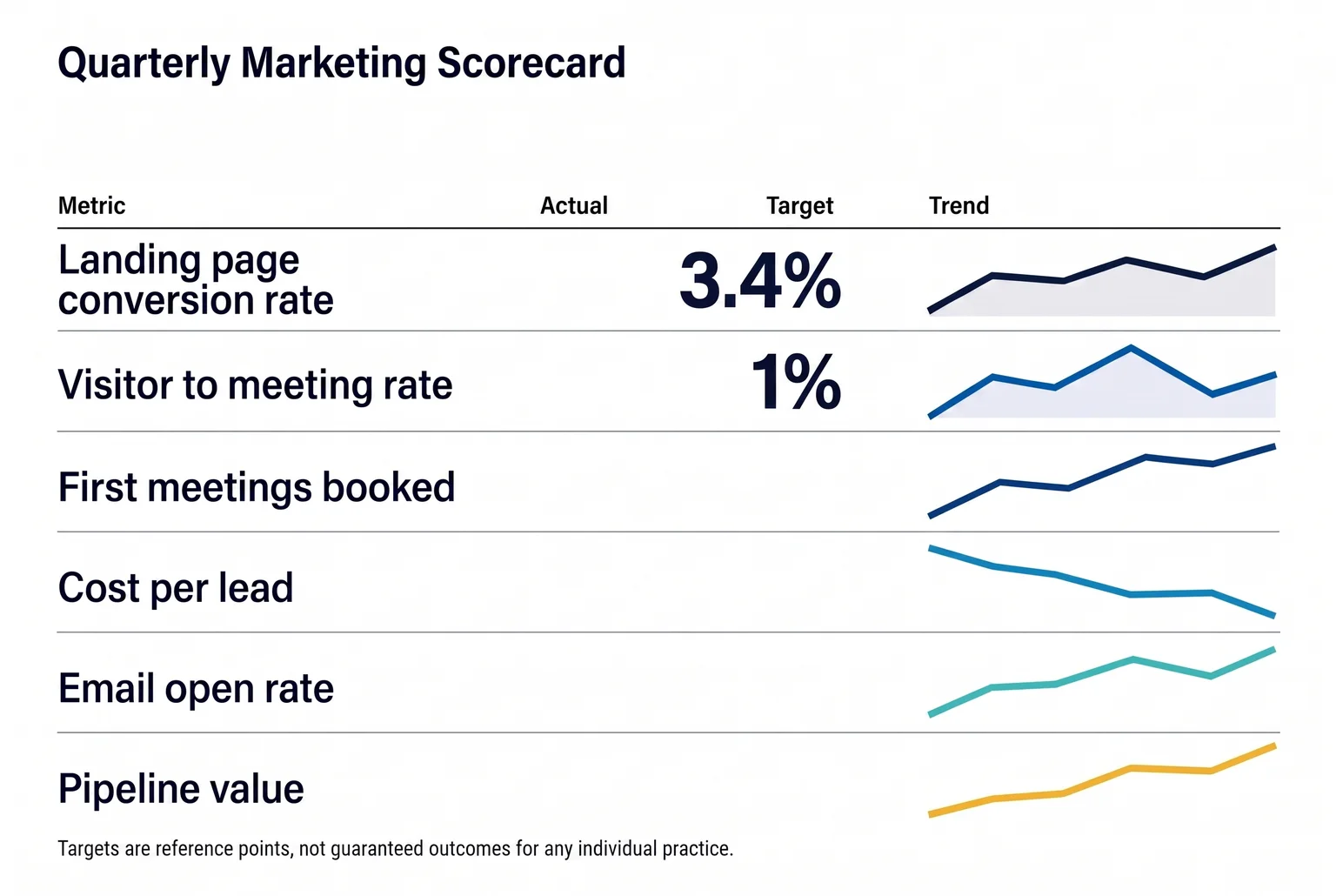
A recommended (not mandatory) cadence is a 60 to 90 minute quarterly review. Structure it loosely around what one marketing framework calls "what we said we'd do": list last quarter's commitments from Steps 2 through 5, note what actually happened, review the scorecard, and pull one or two lessons. Close by setting one or two priorities for next quarter, tied to whichever step needs adjustment, whether that's a channel swap from Step 2, a content gap from Step 3, or a nurture sequence that's stalling in Step 4.
Treat every number as a signal to investigate, not a verdict on your worth as an advisor.
Common questions on running this yourself
How long before I see results? Most advisors notice early signals, more website visitors, a few extra inquiries, within 30 to 90 days from fixing the website, launching basic paid ads, and turning on an email nurture sequence. Channel-level traction usually builds over 3 to 6 months. SEO and content take longer, often 3 to 9 months before they produce consistent organic leads. Reliable new-client flow and measurable ROI generally take 6 to 12 months or more, longer for high-net-worth or high-AUM targets.
What should I budget? Independent firms commonly spend somewhere between 1% and 10% of annual revenue on marketing, with many landing around 2 to 8%. Smaller or newer firms often spend a higher percentage than established practices with steady referral flow.
Can I really do this without an agency? Solo advisors and firms under $10 million in AUM frequently run DIY marketing successfully, since budgets are typically under $1,000 per month and the advisor's own time carries a lower opportunity cost at that stage.
When does it make sense to bring in help? Consider outsourcing specific pieces, like SEO, paid ads, or video, once DIY results plateau or once growth crosses into the $10 million to $30 million AUM range, where specialist support tends to accelerate results while you keep control of strategy.
What if I fall behind on the quarterly review? A late review beats no review. Pick up the scorecard, note what changed, and reset priorities from there.
Your six-step plan, ready to run
You now have a full sequence: define your niche and positioning, pick two or three realistic channels, build a content calendar tied to that positioning, add lead magnets and nurture emails to convert traffic, run every testimonial and claim through SEC Marketing Rule compliance checks, and review results quarterly. Step 5 isn't optional. It governs steps 2 through 4, so build compliance into your workflow rather than treating it as a final check.
This plan is meant to be run by you. If you'd rather hand off execution while keeping the strategy, Pro Financial Design's webpro, leadpro, and videopro plans cover website, lead generation, and video production separately or together. Want a second opinion before you commit budget? Book a marketing diagnostic call to see what's working and what needs fixing first.

ABOUT THE AUTHOR
Cullen Fischel is the lead designer at Pro Financial Design. So, if you’ve ever worked with us, you’ve worked with Cullen on strategy, design, and content creation for your project. Cullen’s got years of experience developing websites, brands, logos, lead magnets, digital marketing strategies, and social and email content for his clients. If you have any questions for him, just send us a message!
Contents

Want more financial advisor marketing tips and guides? Check out: