The Credibility Funnel: A Page-by-Page Map for Independent Financial Advisors
Guide prospective clients from discovery to booked discovery calls without high-pressure sales tactics. See the full 4-stage advisor website framework.
Updated: 10/26/2026 by Cullen Fischel

A credibility funnel: the pages that work like a good first meeting
A credibility funnel is a set of website pages and content that works like a good first meeting. It answers what a prospect wants to know in the order they want to know it, so they can move from researching to ready to book a conversation without pressure. You decide how much to show and when. The prospect decides when to take the next step.
Key points in this guide:
- The stage map: four stages that take a prospect from first recognition to a booked conversation, each with a question, a page, and a next step.
- Trust signals: credentials, disclosures, clear services and fees, and a point of view, presented responsibly.
- The booking step: a short, no-obligation way to schedule an introductory conversation.
Quick Definition: funnel. A sales funnel is the journey a prospect takes from awareness of a service to a purchase or other action. Sellers use it to track progress and remove blockers.
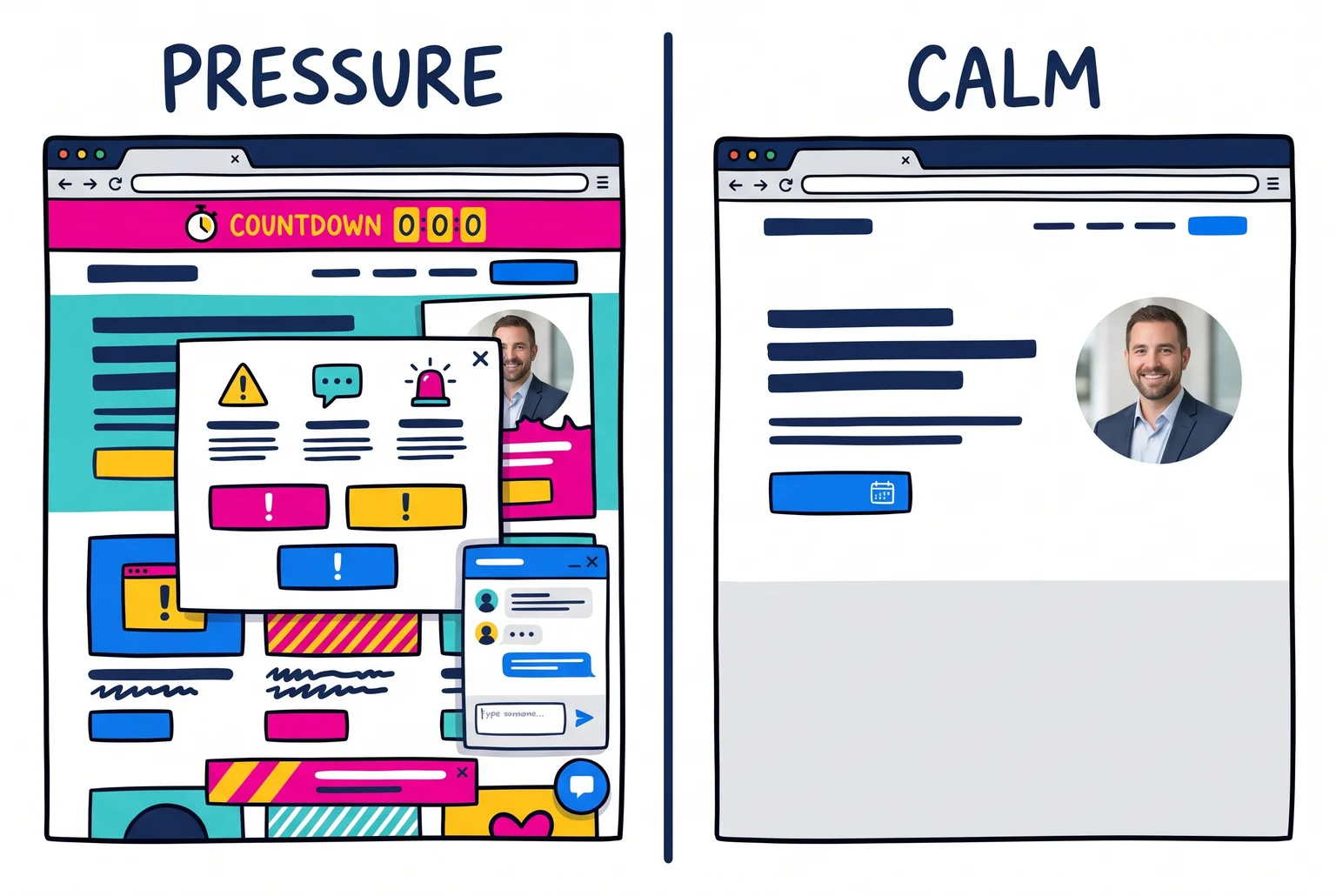
Salesforce lists six stages in a typical funnel: awareness and discovery, interest, consideration, intent, evaluation, and purchase. The structure is useful. The tactics often layered on top of it, such as countdown timers, urgency banners, and gated pricing, fit poorly with a decision as personal as choosing who will see your finances.
Independent advisors have reasons to prefer the calmer version. A solo or small practice usually has one person doing the selling, the planning, and the relationship, so every inquiry needs to be a good fit. Your website is also often the first thing a referred prospect checks before calling. Pages that describe whom you serve, what you do, how you charge, and what the first meeting involves can help that person decide with less guesswork.
The limits are worth stating. A credibility funnel may produce fewer inquiries than an aggressive one, and no page structure can promise a particular number of clients. Compliance shapes the content as well. The SEC marketing rule prohibits materially misleading advertisements, requires a reasonable basis for material factual claims, and sets conditions on testimonials and performance figures. A funnel built on clear, substantiated statements sits comfortably inside those rules.
How prospects choose: a referral, a quiet check, then a slow yes
Most prospects begin with a person. In a February 2024 survey of 775 U.S. clients, 51% cited a referral from family, friends, or a professional network as a leading factor, and 31% cited positive online reviews or testimonials. The Kitces Advisor Marketing Survey, drawn from nearly 1,000 firms, found that nearly two-thirds of clients came through a referral, with all other marketing combined near 10%.
Referral-led does not mean referral-dependent. In Ficomm Partners' study of 1,107 advice buyers, 45% hired based on digital marketing, and the share was 57% for people under 44 against 20% for those 60 and older. These surveys use different samples, so the figures are not directly comparable. They agree on the pattern: a referral often starts the consideration, and online research tests it.

That research is quiet. In a Wealthtender survey of people considering advice, 96% said they would research a highly recommended advisor online, 72% planned to visit the advisor's website, and 97% planned to contact multiple advisors. Prospects also check outside your site. The SEC advises confirming registration, services, fees, conflicts of interest, and disciplinary history, and points to Form CRS, Investor.gov, and FINRA BrokerCheck for free lookups.
So the prospect is comparing several advisors on clarity and credibility, and committing only when the risk feels low. A countdown timer or a "limited spots" banner interrupts that checking. Someone verifying your background does not need a deadline. Pressure may also cut short the due diligence a careful buyer wants to finish, and in many cases the advisor whose site felt calmer gets the call.
Takeaway for your website: Design for a visitor who arrives with your name and a checklist. Make registration, services, fees, and the first meeting easy to find, so verification takes minutes and the next step feels optional.
How pushy funnels and credibility funnels differ
Most advisor sites sit somewhere between the two approaches below. The table shows the patterns side by side so you can spot which ones your own pages use.
| Salesy funnel | Credibility funnel | |
|---|---|---|
| Tone | Urgent, promotional, built around the advisor's pitch | Calm and plain, written the way you would talk in a first meeting |
| Calls to action | "Claim your spot," countdown timers, pop-ups that appear on arrival | One steady invitation to schedule an introductory conversation |
| Content | Bold outcome promises, rankings and results without context | Clear explanations of services, fees, process, and who you serve, with limits stated |
| Information access | Core details gated behind a form | Services, process, and credentials readable before any contact |
| Booking ask | Pressure to decide now, long forms, a sales call | A short form, a described first meeting, and no obligation |
Common Mistake: Pairing a calm design with claims that overreach. The SEC's Marketing Rule prohibits untrue or misleading statements and requires a reasonable basis for material factual claims. The SEC's examinations of newly registered advisers found inaccurate statements about experience, credentials, rankings, and performance, along with claims advisers could not substantiate. Testimonials and performance figures are permitted, but they come with prominent disclosures and fair, balanced presentation, including net performance alongside any gross figures. A restrained tone does not fix a headline you cannot support.
Tradeoffs of the credibility approach
The credibility funnel has costs. It may feel slower, because it does not try to capture a visitor on the first visit. It may produce fewer form submissions, since people can learn what they need without handing over an email address. The inquiries that do arrive tend to come from people who have already read your process and fees, so they may fit your practice better, though no design can promise that.
It also asks more of you up front. Pages that explain fees, process, and who you serve take real writing and review, and each claim needs compliance sign-off. A salesy page is quicker to publish. Some advisors will reasonably prefer a higher volume of lighter inquiries, especially when building a new practice, and a credibility funnel will not suit that goal as well.
The four stages of the credibility funnel
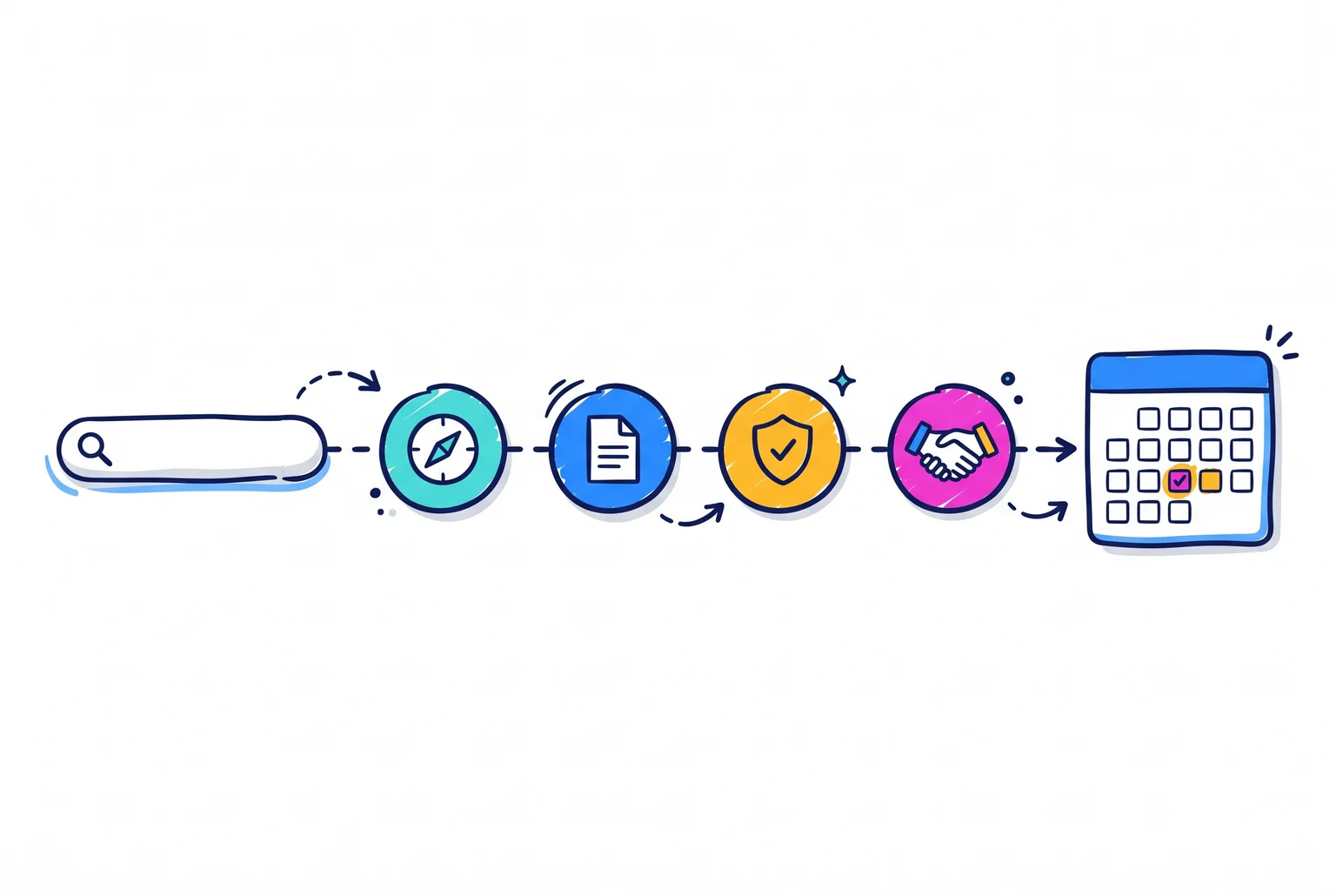
The funnel has four stages, in the order a prospect moves through them: Find and Recognize, Understand and Evaluate, Trust and Verify, then Book with Confidence. The sequence follows a practical design principle for advisor sites: identity first, relevance second, evidence third, and action last. Each stage below gives the prospect's question, the page that answers it, and the next step. The pages themselves are detailed in the next section.
Find and Recognize - Prospect's question: Is this advisor relevant to my situation, and do they serve people like me? - Page that answers it: the home page and a Who We Serve page, which should state the target client, common needs, and your positioning. - Next step: a clear path into Services. - Why this matters: a visitor who cannot place themselves within a few seconds has no reason to read further.
Understand and Evaluate - Prospect's question: How do you work, and is that approach right for me? - Page that answers it: service pages explaining who each service is for, the problems it addresses, the process, and next steps, along with a page on how you are paid. - Next step: a link to your About page or a relevant article. - Why this matters: people compare approaches before they compare people, and a vague service description leaves them guessing.
Trust and Verify - Prospect's question: Are you qualified, legitimate, and safe to engage? - Page that answers it: advisor bios, credentials, regulatory disclosures, location information, and educational resources such as articles. Trust-building elements like these are expected on an advisor site. - Next step: a visible, low-key invitation to talk. - Why this matters: prospects often check your claims independently, so the site needs to hold up when they do.
Book with Confidence - Prospect's question: Is a conversation worth my time, and what happens if I reach out? - Page that answers it: a contact or scheduling page that describes the first meeting. A clear, easy-to-find booking action is the recommended conversion path. - Next step: schedule an introductory conversation. - Why this matters: uncertainty about what follows a click is a common reason a ready prospect hesitates.
Navigation can mirror these stages. One recommended structure is Who We Serve, Services, Advisors, Locations, Insights, About, and Contact or Schedule a Consultation. Not every practice needs all seven. A solo advisor with one office may skip Locations, for example.
The four-stage sequence is a working framework, not a measured formula. Prospects do not move in a straight line, and many will return to an earlier page before booking. The map helps you check that every question has an answer and every page has one next step.
What to put on each page, stage by stage
Have your compliance resource review every page below before it goes live. The lists describe what to include, not approved wording.
Find and Recognize
Home page. Open with one plain sentence naming who you help and how. For example: "We help business owners in their 50s plan the move from working to retirement." Follow it with one line on what a first conversation involves and a single invitation to schedule it. - A who-and-how statement above the fold - Three or four links into Services, Who We Serve, and About - Your photo and location - No performance figures, rankings, or stacked banners
Who We Serve page. Describe the situations you handle well, such as a pending sale of a business or a first year of retirement. Say who you are not the best fit for, which spares both sides a wasted call. - Common needs of your typical client - A link to the matching service
Understand and Evaluate
Services page. State what is included and excluded, how you are paid, how often you bill, any minimums, and potential third-party costs. Prospects look for these answers, so leave nothing to guess. - Who each service is for and the problems it addresses - Fee structure in plain terms - Avoid phrases like "comprehensive wealth solutions" that name nothing
Educational articles and guides. Pick topics your clients ask about: retirement income, Social Security, Medicare, employer plans, IRAs, taxes in retirement, insurance, estate planning, and education funding. Explain risk tolerance, diversification, and volatility without implying outcomes.
Pro Tip: plain-English copy. Write as you would speak across a table. Define each term the first time it appears, keep sentences short, and replace "optimize" and "solutions" with what you actually do. Read the page aloud, and rewrite anything you would not say to a client.

Trust and Verify
About page. Give your name, title, education, experience, licenses, and designations, and explain what each credential means instead of listing initials. Add a short statement of how you work with clients. - A professional photo - Disclosure and regulatory links - Avoid superlatives and unsupported claims of being "the best"
Regulatory disclosures. Registered advisers with a website must post the current Form CRS prominently, in an easily accessible location. Link it from the footer and from the About page.
FAQ. Answer fees, minimums, conflicts, and what you do when a client disagrees. Make costs, compensation, conflicts, and disciplinary history easy to find.
Book with Confidence
Process page. Walk through the first meeting: how long it lasts, what to bring, what you will ask, and what happens afterward, including that there is no obligation.
Contact page. Offer a short form, a phone number, and your office address. Repeat the first-meeting summary beside the form. Skip countdown timers and "limited spots" language. Testimonials and reviews fall under the SEC marketing rule, so route them through compliance before use.
Credibility cues prospects check, and how to show them responsibly
Prospects look for evidence they can confirm without taking your word for it. Each cue below has a limit, so present it with that limit in view.
- Verifiable credentials. Link your IAPD, BrokerCheck, and CFP Board profiles instead of listing initials alone. These confirm registration or certification, but they do not show whether you suit a particular household.
- Regulatory disclosures. Keep Form CRS and your ADV reachable from the footer. Plain placement reads as openness.
- Transparent services and fees. State what you do and how you are paid. Some firms hesitate to publish numbers; at minimum, explain the structure.
- Professional photography. Real photos of you, your team, and your office help a prospect picture the first meeting. They cost money and need updating when people change.
- A clear point of view. A short statement of how you approach planning helps the right prospects self-select, and it may turn others away. That is acceptable.
- Reviews and testimonials, where permitted. The SEC Marketing Rule allows testimonials, endorsements, and third-party ratings with disclosure, oversight, and eligibility requirements. Disclosures generally cover whether the person is a client and whether they were compensated. In 2024 the SEC charged nine advisers over Marketing Rule violations, including missing disclosures on these items. State-registered advisers should check their state's rules, which can differ.
- Consistent branding. Matching logo, colors, and tone across site, email, and meeting materials signals an organized practice.

Common Mistake: overstated claims and stock photos. Words like "best," "top-rated," or "proven" invite scrutiny and read as sales language. Generic stock photos of smiling couples tell a prospect nothing about who they would meet. Replace both with specifics you can support: your credentials, your process, and your own photograph.
Send every testimonial, rating, and endorsement through compliance review before it goes live.
How to set up a booking step that asks for little and explains a lot
A prospect who has read your process page is ready to book. The booking step should confirm what they already expect: a conversation, not a pitch.
The call to action can be as plain as "Schedule an introductory conversation." Pushy versions ("Claim your spot," "Only three openings this month") add urgency the decision does not have.
- Place one steady invitation in the header, at the end of key pages, and on the contact page.
- Keep the form short. Name, email, phone if you want it, and an optional question. Collecting only what you need to follow up is standard guidance, so leave out detailed financial questions. Put labels above the fields.
- Explain the meeting beside the form. Say what you will cover and who attends. State that it carries no obligation, as Mills Wealth Advisors does by calling its discovery call free, no-pressure, and without obligation.
- State length and preparation. Published examples vary: 45 to 60 minutes at one firm, 60 to 90 at another. Use your own. Say nothing is required, and that statements or tax returns are welcome if they help.
- Confirm immediately. Show the time, format, advisor, and rescheduling steps on screen and by email.
- Follow up briefly. Send a short, factual note tied to their question, then stop after a set number of messages. Have compliance review the language before it is automated.

The tradeoff is volume. A short form with a clear no-obligation explanation may draw fewer inquiries, but those who book tend to arrive knowing what the meeting is.
A self-audit checklist and answers to common questions
Check your current site against these points.
- A visitor can tell who you serve and how you help within a few seconds.
- Services, process, fees, about, and contact pages each answer one clear question.
- Credentials link to regulator or certifying-body lookups.
- The first meeting is explained: length, attendees, preparation, no obligation.
- One steady invitation to schedule appears throughout, with no countdowns or pop-ups.
- Reviews, performance, and linked third-party content have had compliance review.
How many pages do I need? A practical launch is six pages (Home, Services, Our Approach, Fees, About, Contact) plus legal disclosures in the footer. Add pages only when they answer a distinct prospect question.
Do I need a lead magnet? Not always. It may help when you have steady traffic and can maintain the content. A referral-driven firm may do well with a direct introductory meeting.
How long does trust take? It varies. In one WealthManagement.com survey, nearly 60% of affluent investors became clients within a month of becoming prospects, while 15% took a year or longer. Cold digital leads may take 3 to 12 months.
How do I stay compliant? The SEC Marketing Rule permits testimonials, endorsements, and performance with conditions on disclosure, oversight, and presentation. Have your compliance team review everything before publishing, including pages you link to.
Request a website review from Pro Financial Design
A credibility funnel gives a prospect what a good first meeting gives them: clear answers, visible credentials, and an easy next step. You can compare your current site to the four stages and see which pages are missing or unclear.
Pro Financial Design works only with financial advisors and builds with marketing compliance in mind. You can request a website review or schedule a free, no-obligation strategy call to talk through your practice, your clients, and the pages it needs.

About Cullen Fischel
Cullen Fischel is the lead designer at Pro Financial Design. So, if you’ve ever worked with us, you’ve worked with Cullen on strategy, design, and content creation for your project. Cullen’s got years of experience developing websites, brands, logos, lead magnets, digital marketing strategies, and social and email content for his clients. If you have any questions for him, just send us a message!
Contents

Want more financial advisor marketing tips and guides? Check out: