
Compare five testimonial page for website layouts built for advisors, with notes on what to disclose, approve and avoid under the SEC Marketing Rule.
Updated: 11/06/2026 by Cullen Fischel

How to add client testimonials to your advisory website under the SEC Marketing Rule
You can put client testimonials on your website, but the SEC Marketing Rule attaches conditions to them. The SEC adopted the rule on December 22, 2020, and it allows testimonials and endorsements in advertisements when disclosure, oversight, written-agreement and disqualification requirements are met. Plan those conditions before you pick a layout, because they shape where text goes and who signs off.
This post covers:
- What the rule asks of any testimonial page
- Five layouts you could adapt, each with compliance notes
- How video and case studies compare with text quotes
- How to collect, build, mark up and review the page
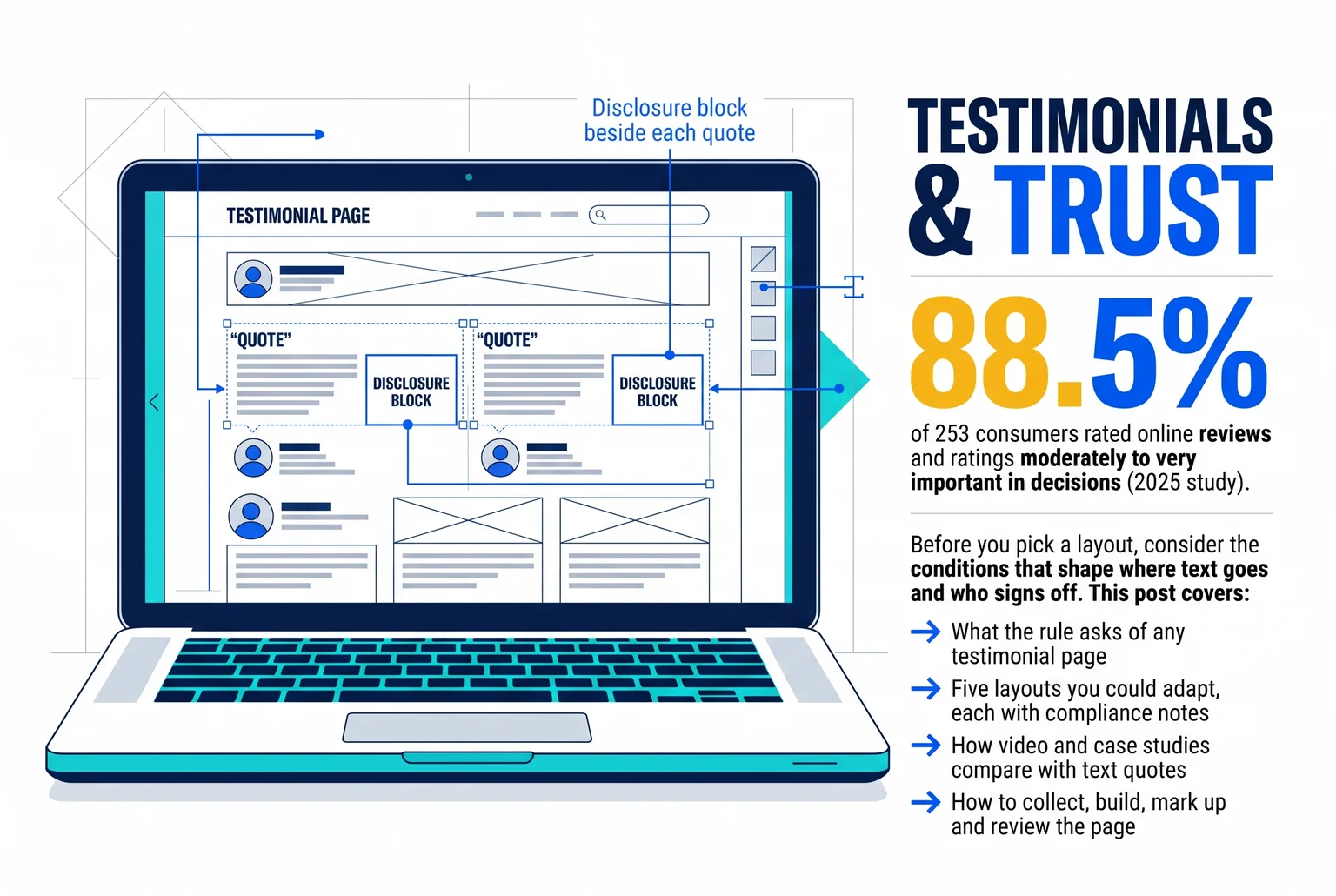
Testimonials work because prospects trust other clients more than your own claims. One 2025 study of 253 consumers found 88.5% rated online reviews and ratings moderately to very important in decisions. That study covers general consumers, not advisory websites, but the pull is plausible for a high-trust service. The same persuasive power is why regulators look closely. A testimonial can leave a misleading impression, and the rule's general prohibition on materially misleading advertising applies to it.
Quick Definition: A testimonial is a statement by a current or former client about their experience with you. An endorsement is a similar statement by someone who is not a current client, such as a prospect or a referrer. Compensation can change what you must disclose.
Throughout this post, the running example is Harbor Lane Wealth, a fictional two-advisor RIA building its first testimonial page. If you want to see how proof fits into the rest of a site, the advisor web design guide covers it.
This is educational content, not legal advice. Have compliance counsel review any final page before it goes live.
The rule's conditions for testimonials and endorsements, as a checklist
Every layout in the next section points back to this list. Rule 206(4)-1 permits testimonials and endorsements when disclosure, oversight and disqualification conditions are met, and written agreements come into play when someone is paid.
Testimonial or endorsement. A testimonial comes from a current client or investor. An endorsement comes from someone who is not, such as a referral partner. Compensation includes cash and non-cash benefits, so a gift card or a free service counts.
Disclosures. At the time of dissemination, the page needs to show whether the speaker is a client, whether compensation was given, and a brief description of material conflicts of interest. The adviser may make these disclosures or reasonably believe the speaker does. The rule calls for them to be clear and prominent, and what satisfies that on a given page is a question for counsel.
Oversight. You need a reasonable basis for believing each testimonial complies, and records that substantiate that basis must be kept.
Written agreements. Paid promoters generally need one, with exceptions that include affiliates and compensation of $1,000 or less over 12 months. Confirm the current thresholds and how they apply to you before relying on them.
Disqualification. You may not compensate someone for a testimonial or endorsement if you know, or should know through reasonable care, that they had a disqualifying event within the preceding 10 years.
Third-party ratings. A "best advisor" badge generally needs its date, rating period, issuer and methodology disclosed, along with any compensation or conflicts. In an April 17, 2024 Risk Alert, SEC examiners flagged ratings that implied sole or highest recognition when there were multiple recipients, and ratings that omitted methodologies based mainly on assets under management, client counts or employee nominations.
Common Mistake: Posting a client's praise of a third-party product, such as a custodian platform, in a way that reads as praise for your advisory services. Examiners flagged exactly this in the same Risk Alert.

Open questions for counsel: how prominent is prominent enough on mobile, whether a state-registered firm faces added rules, and how your referral arrangements fit the compensation tests. Your marketing plan is a good place to record those answers once you have them.
Five testimonial page layouts for an advisor website, with compliance notes
These are illustrative patterns, not named real pages, and no layout is automatically compliant. Each is applied to Harbor Lane Wealth, and counsel should review the final version.
1. Text quote grid with a disclosure block
Six short quotes sit in two columns on desktop and one on mobile, each with a first name, last initial and relationship length. Short quotes read faster on small screens, and Nielsen Norman Group research found complex content is much harder to understand there. Place disclosures of client status, compensation and material conflicts beside the quotes. Get written consent and a dated review for each quote, and avoid a wall of praise that looks cherry-picked.
2. Featured quote with client-given context
One quote leads, with a photo and a sentence on why the client came to Harbor Lane. Supporting quotes follow, grouped by situation such as retirement or business sale, a recommended testimonial page pattern. Attach the same disclosures to the featured quote, use the client's own wording for the context, and never edit in ways that change meaning.
3. Third-party rating summary
A badge or rating sits above a short panel. Disclose the rating date, evaluation period, provider and any compensation tied to the rating. Keep a reasonable basis that the survey allowed favorable and unfavorable responses equally, and avoid implying sole or top recognition when others share it. Review links, such as a Google Business Profile, may also count as testimonials.
4. Video testimonial gallery
Three short videos carry captions and transcripts. Faces and voices make attribution easy to believe. Confirm with counsel whether disclosures belong in the video, on the page, or both, and approve the final cut, not only the raw footage. Avoid autoplay and tiny mobile controls.
5. Case-study page
A story covers the client's situation, the planning steps and the client's own words. Detail makes the testimonial relevant. Include the standard disclosures, substantiate any outcome claim, and avoid results that imply what other clients can expect.
Tradeoff across all five: The richer the format, the more you must disclose, approve and keep on file.
Choosing between text, video and case-study formats
Vendor-published figures favor video: one source reports 71% of consumers felt more confident after watching video testimonials versus 38% after reading written reviews. These come from marketing platforms and general consumer data, not from studies of financial advisors, so treat them as directional. Compliance burden and production effort are the clearer differences.
Take one Harbor Lane Wealth client, a retired teacher who says the firm made her income plan easier to follow.
- Text quote: Her sentence appears with first name, client status and a compensation disclosure beside it. Effort is low, and the risk is mostly editing that changes meaning or omitting a disclosure.
- Video: She says the same thing on camera. Effort is higher, and every cut, caption and spoken line needs approval. Disclosures may need to be seen or heard in the video itself and on its page, so confirm placement with counsel. Google also recommends the video sit on an indexed watch page.
- Case study: Her situation, the planning steps and her words fill a page. Any quantified result, such as a return or a multiple, may be treated as performance and trigger the rule's presentation conditions. That makes this the highest-risk format.
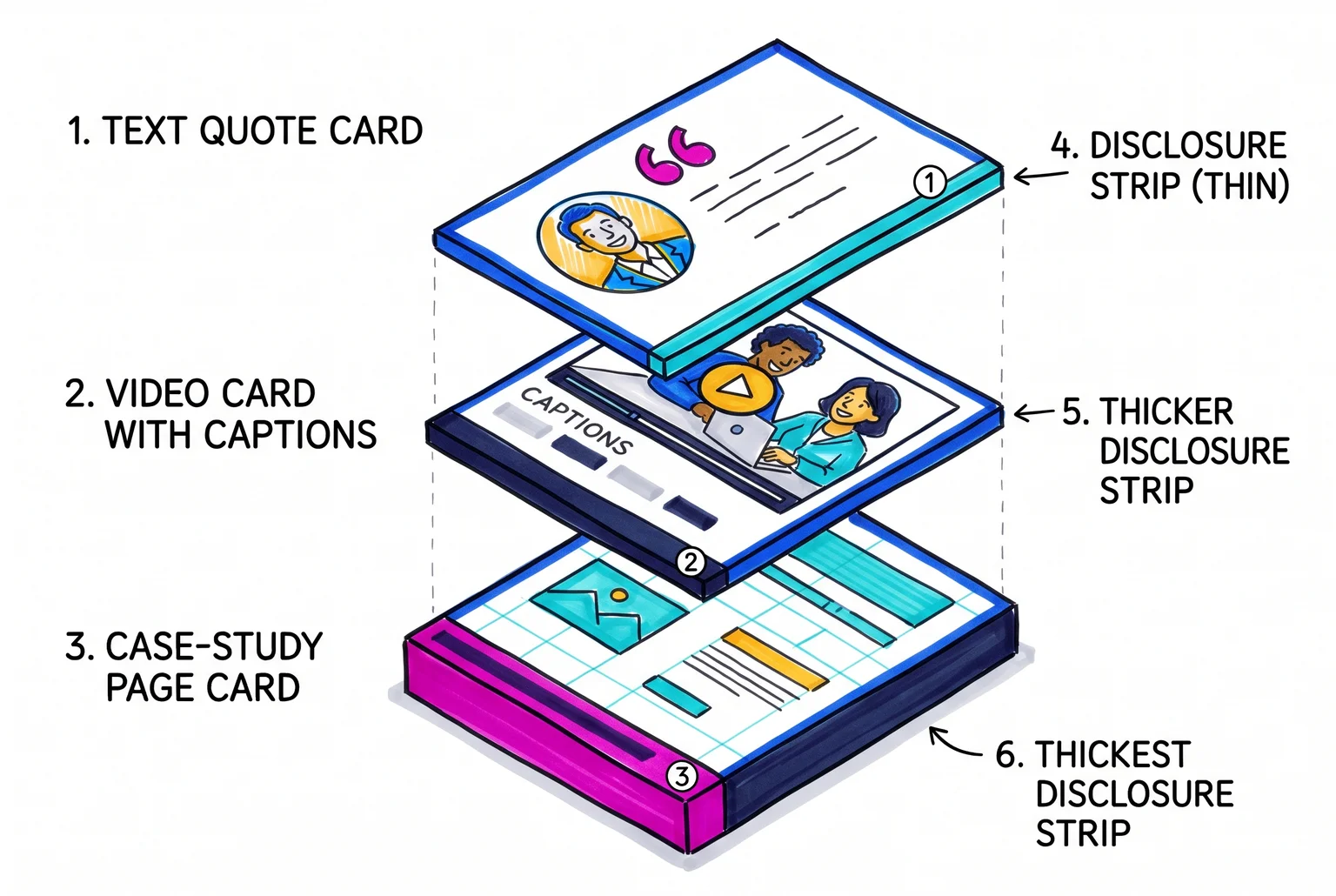
| Format | Effort | Compliance burden |
|---|---|---|
| Text quote | Low | Lower |
| Video | Medium to high | Medium to high |
| Case study | High | Highest if results appear |
Pro Tip: Pre-approve the script or talking points before filming, then approve the final cut again. Approving only the script leaves spoken changes unreviewed.
A two-advisor firm could start with text quotes, add video once its approval workflow is steady, and write case studies without numeric results unless counsel signs off.
How to collect testimonials compliantly
The SEC does not publish a safe-harbor email for testimonial requests, so each firm has to document a reasonable basis for its own process. Have counsel review your template and recordkeeping before use.
- Decide what to ask for. Request feedback in the client's own words, with no promised results.
- Choose the timing. Harbor Lane Wealth asks a long-term client after a routine review, not during a market drop or a fee discussion.
- Get written permission. Require approval of the final version before publishing.
- Limit edits. Suggest factual, grammatical or length changes only if the client's meaning stays intact.
- Keep records. Retain the original submission, edits, permission, disclosures, any benefits given and compliance sign-off.
An unsolicited client note can still fall under the rule if you republish or embed it.
Sample request email
Subject: Would you share your experience with us?
Hi Margaret, thank you for working with us these past nine years. If you are open to it, we would value a few sentences, in your own words, about working with Harbor Lane Wealth. We cannot suggest what to say or promise any result. Nothing is published without your written approval of the final text, and you can decline or withdraw at any time without affecting our service to you.
Permission outline: confirm the text, name display, client status, that no compensation was given, any conflicts, and the right to withdraw.
A gift, fee discount or prize may count as compensation, including non-cash. Compensation can add disclosures and a written agreement, so many firms offer none.
Building the Harbor Lane Wealth page, step by step
Harbor Lane Wealth builds its page in this order. Disclosure must be clear and prominent, and counsel should confirm the final wording.
- Set the goal. The page shows prospects what clients have said and points them to a next step.
- Write a plain headline. The SEC guide treats factual headings like "Client Experiences" or "What Clients Say" as acceptable. Superlatives such as "Best Advisor" are out.
- Set expectations in the intro. Say these are individual views, not a guide to what you will experience.
- Build the quote modules. Put the source-status, compensation and conflict disclosures directly beside each quote, not in a distant block.
- Add approval notes. Show the review date and a one-line description of your review process.
- Link firm documents. Add Form ADV Part 2A or Form CRS where they fit.
- Close with a restrained call to action. "Schedule an introductory conversation" or "Request the firm brochure" works. "Get the same results" does not.
- Finish with footer disclosures.
For navigation, About, Clients or Resources are common homes, with links from service pages, the homepage and the footer. A dedicated page centralizes review and updates, but it does not cover testimonials repeated elsewhere. The Marketing Rule also covers organic content, so a quote on the homepage needs the same disclosures and approval.
Launch checklist
- Every quote has adjacent disclosures.
- Every instance of every quote is listed in your records.
- Counsel has signed off.
Making the page findable without review markup
Structured data (schema) is code that labels page content so search engines can read it. Schema.org defines Review and Rating vocabulary, but using it does not guarantee Google rich-result eligibility, per Google's review snippet guidance. That guidance also says review markup should name a specific item, and Google's policies say ratings and counts must reflect genuine, visible content. Turning Harbor Lane's client quotes into star ratings or an aggregate score would invent numbers the clients never gave, and could sit badly with fair-and-balanced requirements. Plain testimonial text is the safer choice.
Practical notes:
- Use a descriptive title and H1, such as "Client Experiences | Harbor Lane Wealth".
- Publish quotes as page text, not images or PDFs. Add meaningful alt text to photos, but keep the visible copy.
- Link from service pages to the testimonial page in context, with varied anchor text and crawlable links.
- Use the phrase "testimonials on a website" naturally in an intro or FAQ if it fits.
- For video, VideoObject markup does not guarantee video visibility.
For layout on phones, see our mobile design post. For budgeting, see our redesign cost post.
A copy-ready checklist for your compliance review
Bring this to counsel as a starting point. It does not guarantee compliance, and answers depend on your registration status.
Disclose - Whether each speaker is a client or non-client, next to the quote. - Any cash or non-cash compensation, including prizes, reduced fees or directed brokerage. - Material compensation terms and conflicts.
Approve and document - Each quote's classification, rechecked before reuse. - A written agreement with paid promoters, unless an exception applies. - Your reasonable basis for believing the page complies.
Avoid - Vague disclaimers, or disclosures that sit only behind a link. - Paying a promoter with a known disqualifying event. - Relying on disclosure to fix a misleading quote. - Labeling the page "SEC Marketing Rule compliant."
Questions for counsel - Does the federal rule apply to us, or do state rules? - Do any incentives count as compensation? - Which quotes need reclassifying?
Common questions about client reviews and testimonials
Can I use client reviews on my site? Possibly. A review may become a testimonial when your firm requests, curates, quotes, links to, or republishes it, so the disclosure steps in the rule summary section may apply.
Can I display Google reviews? Third-party reviews can be shown, but incorporating them into your website may make them advertisements. Google also prohibits incentives for posting reviews.
Are unsolicited testimonials treated differently? Not automatically. SEC examiners have flagged advisers that reproduced testimonials without clearly identifying the speaker's status.
How long can I keep an old one? The research reports no fixed expiration date, but a dated quote may become misleading. If a client leaves, the statement may need reclassifying as an endorsement.
Must I show negative reviews? The rule does not require equal numbers of positive and negative testimonials, but the page's overall context must not mislead.
Who approves the page? Your chief compliance officer or outside counsel, ideally before launch.
Talk with us about a testimonial page for your firm
Pick a layout, match it to the rule's disclosure and oversight steps, and have counsel review the final page. If you want help building it, Pro Financial Design can talk through a custom website for financial advisors, including a testimonial page. The webpro plan is one option. We design the page, and your compliance team or counsel approves the content. We don't provide legal or compliance approval.

About Cullen Fischel
Cullen Fischel is the lead designer at Pro Financial Design. So, if you’ve ever worked with us, you’ve worked with Cullen on strategy, design, and content creation for your project. Cullen’s got years of experience developing websites, brands, logos, lead magnets, digital marketing strategies, and social and email content for his clients. If you have any questions for him, just send us a message!

Want more financial advisor marketing tips and guides? Check out:



On-page SEO factors for advisor websites: how to structure headings, trust signals, internal links, and calls to action so pages rank and drive inquiries.